No Way Out
Marriage, Constraint, and the Limits of Choice

It is easy to be drawn to the story of poison, to the idea of a substance so carefully made that it leaves no trace of itself, slipping unnoticed into wine or broth and taking effect slowly, over days or weeks, its presence only understood when it is already too late. The accounts of acqua tofana have endured for centuries for this reason, occupying that uneasy space between documented history and something closer to legend.

But the story does not begin with poison itself; it begins with the lives in which such a thing might come to be imagined at all.
Across much of seventeenth-century Europe, women had very few socially or legally recognised ways to leave a marriage. Legal identity was limited, property was rarely her own, and separation, where it existed at all, was difficult to secure and often carried significant social consequence. A husband might be chosen for her rather than by her, and once married there was little opportunity to alter the course of that life. For many women, endurance was not so much a choice as a condition of living.
However, the desire for release found different forms, shaped as much by belief as by circumstance. In England, some women turned not to action but to prayer, directing their hopes towards Saint Wilgefortis, a figure associated with deliverance from unwanted marriage. According to tradition, she asked to be spared from a union imposed upon her and was transformed in such a way that the marriage could not proceed; a beard grew upon her chin and then her father had her crucified. Known in some places as Uncumber, she became a focus for women seeking relief from the burdens of their situation, an appeal not for harm, but for intervention.
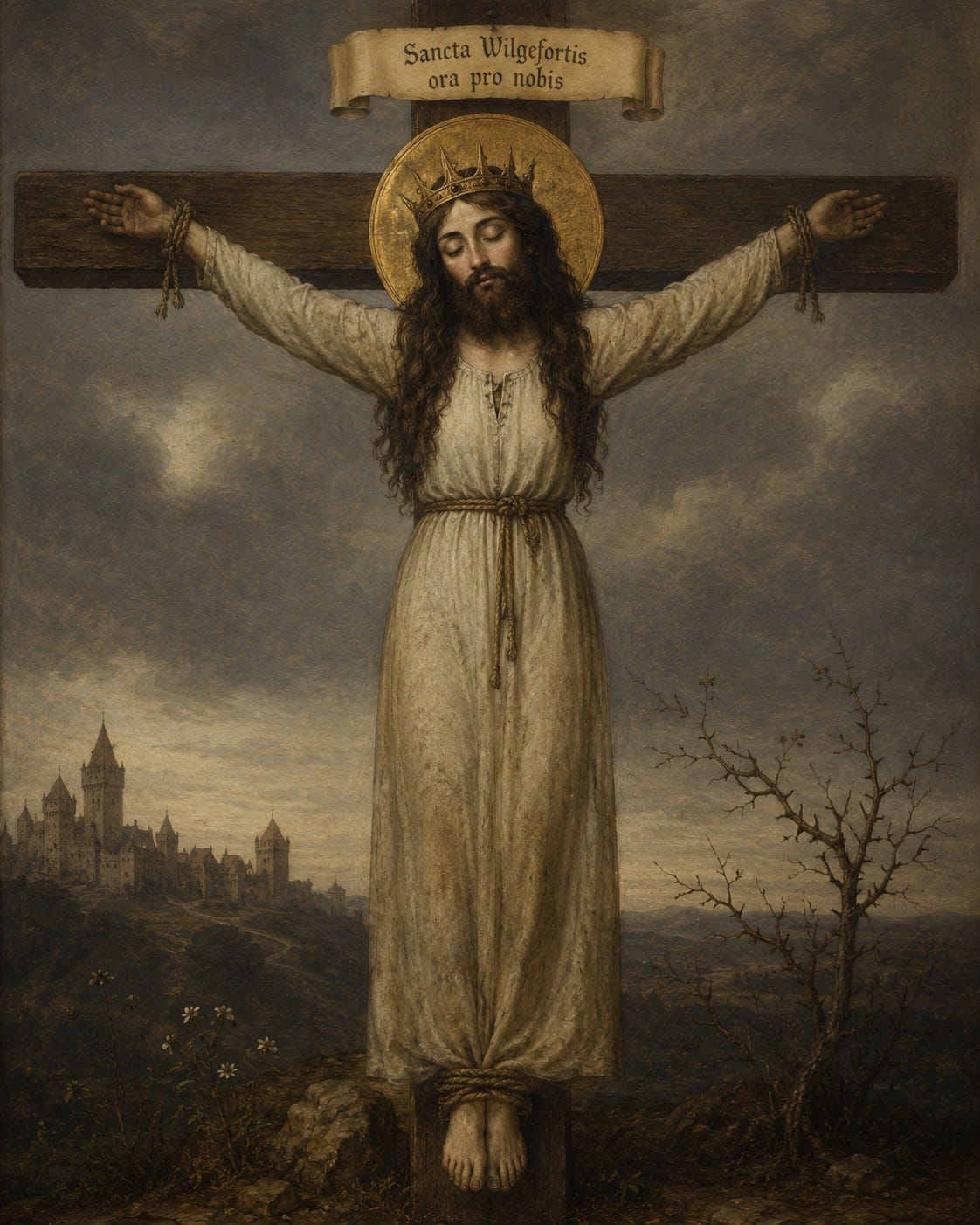
The same desire, however, did not always remain within the bounds of belief or prayer. The stories surrounding Giulia Tofana describe a network of women providing a substance that was said to be odourless, tasteless, and easily concealed, something that could pass unnoticed until its effects could no longer be ignored. Whether every detail of these accounts is accurate is less important than the persistence of the narrative itself, which points to a wider recognition that, for some women, there were no acceptable or sanctioned means of escape.
This is not a story that offers easy conclusions, nor one that lends itself to simple judgement; rather, it invites consideration of the narrowness of choice and the different ways in which women, across time and place, have tried to live within it.
To understand these responses more fully, it is necessary to consider what marriage itself meant in practical terms, not simply as a social expectation but as an economic and legal arrangement from which there were few straightforward exits.
In England, the doctrine of coverture meant that a married woman’s legal identity was, in effect, absorbed into that of her husband. Property, earnings, and contracts were not hers to control independently, and while customs varied across regions and classes, the general principle held that marriage altered a woman’s relationship not only to her household but to the law itself. What this meant in everyday terms was that leaving a marriage, even a deeply unhappy one, was rarely a viable option.
Widowhood, however, occupied a different position. Upon a husband’s death, a woman might regain a degree of legal standing that had previously been denied to her. In some cases, she could inherit a portion of his estate or manage property on behalf of her children, particularly if they were still young. A dower, often set at a fraction of the husband’s holdings, could provide a form of ongoing support, allowing her to remain within the household or maintain a degree of independence.
Yet this was not a simple transition from constraint to freedom. Inheritance was not always straightforward, and property might pass directly to male heirs, leaving a widow dependent on arrangements made by others. Extended family could exert influence, and the expectation of remarriage often remained, particularly where economic survival depended upon it. Even where a woman gained some measure of control, it was shaped by circumstance rather than choice.
For those with children, the situation became more complex still. Responsibility for their care, upbringing, and future prospects would fall heavily upon the mother, and any shift in household structure carried implications not only for her own position but for theirs. The desire for change, however it was expressed, could not be separated from these considerations, which bound women not only to their marriages but to the wider network of family and obligation.
Seen in this context, the idea of escape becomes less clear cut. What might appear, at a distance, as a decisive act or a moment of release was entangled in questions of survival, responsibility, and uncertainty about what would follow.
The distinction between these responses is not only in what they sought to achieve, but in the risks they carried. To turn to prayer was, in many ways, to remain within the accepted structures of belief, to express a desire for release without stepping beyond the boundaries of what was socially or legally permissible. If no change followed, the act itself left little trace.
To act more directly, however, introduced a different kind of uncertainty. Any intervention that could be traced or suspected carried the possibility of serious consequence, not only in terms of punishment but in the disruption it would bring to the household and to those dependent upon it. The outcome, even if successful in its immediate aim, could not be separated from the potential cost that might follow.
It is easier, at a distance, to imagine these marriages through a softened lens, shaped by stories that emphasise courtship, choice, and the possibility of affection, where attention rests on the moment of selection, as though marriage itself resolves what comes after. Yet the reality for many women was far less certain, and the conditions within which they lived were not undone by the presence or absence of feeling.
Even now, it is understood that marriage, however it begins, does not in itself offer protection from imbalance, coercion, or harm. Looking back, then, is not simply to contrast past and present, but to recognise how limited the safeguards once were, and how little room there was to respond when things went wrong.
Set alongside one another, these responses begin to form a spectrum rather than a set of isolated acts. Some women turned to prayer, directing their hopes towards a form of intervention that asked for change without transgressing the boundaries placed upon them. Others, as the stories of acqua tofana suggest, acted in ways that stepped beyond those limits, accepting a level of risk that could not be separated from the outcome they sought. Between these two points lies the far less visible majority, those whose lives unfolded without recourse to either, or whose experiences remain largely unrecorded.
It would be easy to draw these accounts into a narrative of ingenuity or defiance, to see in them a kind of resourcefulness shaped by necessity. Yet to do so risks overlooking the conditions that made such responses conceivable in the first place. These were not solutions in any straightforward sense but attempts to navigate situations in which the available choices were already constrained, and in which any form of change carried its own uncertainty.
For those who acted, the consequences, if discovered, could be severe, extending beyond the individual to affect children, households, and reputations in ways that were difficult to contain. Even where the desired outcome was achieved, it did not necessarily resolve the wider questions of survival, responsibility, or social position that followed. For those who did not act, endurance was not passive so much as necessary, shaped by circumstance and by the limits of what could be altered.
What remains, then, is not a question of judgement, but of understanding the conditions within which these lives were lived. The stories of saints, of substances, and of endurance each point towards the same underlying reality: that for many women, there was no clear or acceptable way to leave, and that the forms of resistance available to them were shaped as much by constraint as by intention.
It is difficult not to think of the women who came before us, including those within our own families, and to wonder how many endured circumstances they would never have described as choice simply because no other path appeared possible to them.
An extremely thoughtful and deeply reflective piece Sandra. I especially appreciated the way the article avoids easy judgement and instead focuses on the limited choices many women faced. It’s the kind of historical writing that encourages empathy as much as understanding.